
Have you ever been petting your cat, enjoying a calm moment, and then suddenly felt teeth or claws on your hand? I asked myself why does my cat attack me after petting more times than I can count. My own cat would purr one minute and then bite the next, which left me confused and a little hurt. After years of living with cats and learning more about feline behavior, I found that these reactions often have clear reasons.
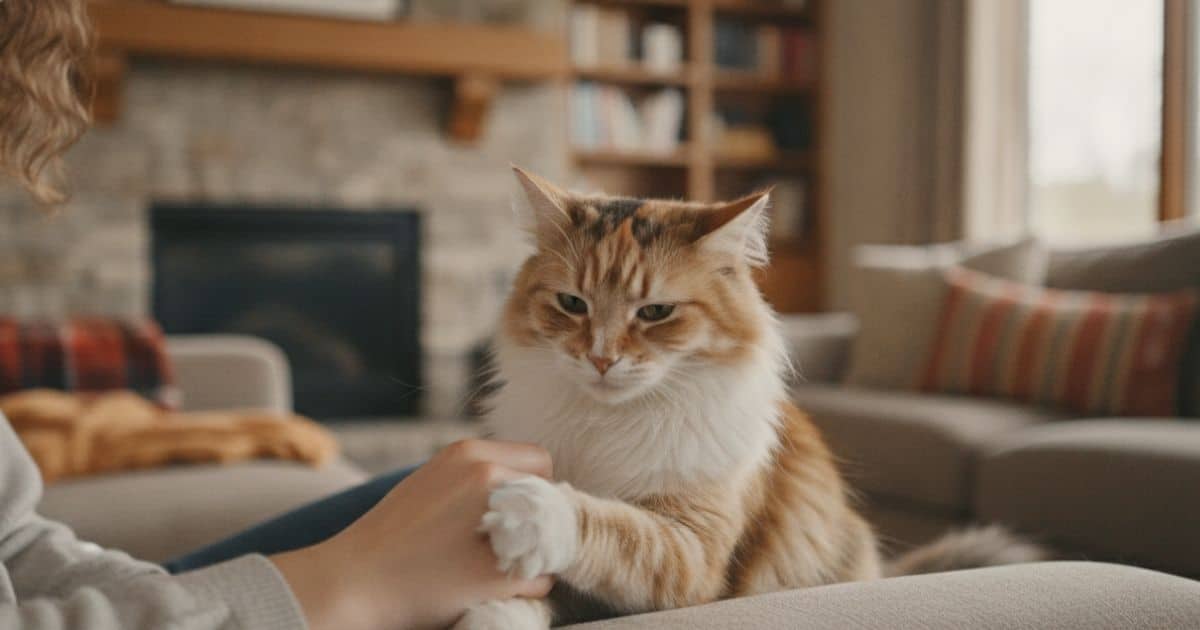
If you have wondered why your cat bites you when you pet him, why he scratches you mid-session, or why he bites after a few minutes of attention, you are not alone. In this guide, I will share what I learned, the signs I missed, and the simple changes that improved my bond with my cat.
Why Does My Cat Attack Me After Petting?
Most cats attack after petting because they become overstimulated, touch a sensitive spot, feel stressed, or want the interaction to stop. According to the Cornell Feline Health Center, repeated stroking can overload a cat’s tactile receptors faster than many owners expect, turning a pleasant interaction into an irritating one within seconds. In many cases, the behavior is not true aggression — it is a form of communication. When I first started asking myself this question, I thought I was doing something wrong. My cat would walk over, rub against my leg, and ask for attention. Then, after a minute or two of petting, she would suddenly bite my hand. It seemed random at first. Later, I learned that cats give signals before they react. The problem was that I did not know how to read them.
Petting-Induced Aggression
Petting-induced aggression happens when a cat enjoys touch at first but then reaches a point where more contact becomes too much. This is one of the most common reasons a cat bites or swats during a cuddle session. Think of it like listening to your favorite song on repeat — fun at first, then something you want silence from. Every cat has a different tactile threshold. Some tolerate long petting sessions; others reach their limit in seconds. I remember sitting on the couch one evening while my cat purred beside me. Everything seemed fine. Then she turned and nipped my hand. There was no warning I could see — until I started watching her more closely over the following weeks. Her tail would twitch. Her ears would shift. Those small signals changed everything.
Your Cat Becomes Overstimulated
Repeated petting can overload a cat’s senses and trigger a sudden bite, scratch, or swat. Cats have dense nerve endings in their skin, and a few strokes can feel pleasant while too many become irritating — what behaviorists call crossing the overstimulation threshold. Imagine someone tapping your shoulder again and again. At first you don’t mind. Eventually it becomes annoying. Even very affectionate cats have limits. My own cat loves head rubs, but if I keep going past her threshold, she lets me know immediately. Learning where that line sits made a real difference in our relationship.
Sensitive Areas Trigger a Reaction
Some parts of a cat’s body are more sensitive than others and are more likely to trigger a defensive response. Cats generally prefer contact around the head, cheeks, and chin, while these areas tend to provoke a reaction:
- Belly
- Tail base
- Back legs
- Paws
A cat that rolls onto its back is often showing trust, not requesting belly rubs. I learned that lesson the hard way — my cat rolled over, I reached for her belly, and within seconds my hand had become a wrestling toy. If your cat reacts strongly any time you touch a particular spot, even outside of petting, it’s worth handling that area carefully during routine care too. Our guide on how to safely restrain a cat for grooming covers gentle techniques for handling touch-sensitive cats during brushing and nail trims.
Your Cat Is Trying to Control the Interaction
Many cats prefer choosing when affection starts and stops. They often like physical contact on their own terms, and when they decide an interaction is over, a bite, paw swipe, or quick scratch is sometimes how they signal it. This doesn’t mean your cat dislikes you — some of the most affectionate cats also keep the firmest boundaries. I noticed my cat was happier when I let her initiate. Instead of reaching for her every time I wanted contact, I waited for her to ask first. That single change cut unwanted bites almost overnight.
Stress or Anxiety Makes Cats More Reactive
A stressed cat is more likely to react negatively to touch. Cats thrive on routine, and small disruptions can shift their mood. Common stress triggers include:
- Moving furniture
- New pets
- House guests
- Loud noises
- Changes in routine
If you live in a multi-cat household, tension between cats can also spill over into how tolerant each one is of petting — our piece on why cats lick each other and then fight digs into that dynamic in more detail. I once noticed my cat became far more reactive during a week when relatives stayed at our house. Once the house returned to normal, so did her patience for affection.
Redirected Aggression — A Cause Many Owners Miss
One trigger that’s easy to overlook is redirected aggression. This happens when a cat becomes aroused or agitated by something it can’t reach — a bird outside the window, a noise, an unfamiliar animal — and then “redirects” that energy onto the nearest available target, which is often the hand that’s petting it. Unlike ordinary overstimulation, redirected aggression usually comes on fast and hard, with little or no warning posture beforehand, because the cat’s arousal started somewhere else entirely. If your cat suddenly attacks during otherwise calm petting and you notice something happening nearby — another animal, a loud sound, motion outside a window — redirected aggression is worth ruling out before assuming the petting itself was the cause. Giving the cat time alone to calm down, rather than continuing to handle it, is usually the right response.
Pain or Medical Issues
Pain can make a cat react defensively when touched. Sometimes the answer isn’t behavioral at all — it’s physical discomfort. Medical causes can include:
- Arthritis
- Skin irritation
- Injuries
- Dental pain
- Other painful conditions
If touching a certain area causes pain, your cat may bite or scratch instinctively to protect itself. If skin irritation seems to be part of the pattern, our skin and coat care service is worth a look — addressing the underlying skin issue often resolves the “aggression” entirely.
When to Schedule a Vet Visit
Contact your veterinarian if the aggression appears suddenly or comes with signs of illness or discomfort. The American Association of Feline Practitioners (AAFP) recommends a veterinary exam any time a previously tolerant cat develops sudden aversion to touch, since this is one of the more reliable behavioral indicators of underlying pain in cats. Watch for:
- Sudden changes in behavior
- Limping or stiffness
- Loss of appetite
- Hiding more than usual
- Excessive grooming
- Crying when touched
- Aggression that continues to worsen
A cat that suddenly starts attacking after petting may be trying to communicate that something is wrong. When in doubt, a veterinary checkup is the safest choice.
Why Does My Cat Bite Me When I Pet Him?
If your cat bites you during petting, the most common reasons are overstimulation, play behavior, communication, or learned habits. In many cases, the bite is your cat’s way of saying “I’ve had enough.” I remember asking this exact question after what seemed like a perfect cuddle session — purring, rubbing, every stroke seemingly welcome, and then suddenly teeth on my hand. At first I thought she was angry. Later I learned that not every bite means aggression.
Love Bites vs. Aggressive Bites vs. Overstimulation Bites
Telling these apart is one of the most useful skills a cat owner can build, since the right response is different for each.
| Bite type | What it looks like | Body language before the bite | What it usually means |
|---|---|---|---|
| Love bite | Gentle, light pressure, rarely breaks skin | Relaxed body, slow blinking, purring | Affection or social bonding |
| Overstimulation bite | Quick nip or grab, moderate pressure | Tail flicking, ears shifting, skin twitching | “That’s enough touch for now” |
| Aggressive / defensive bite | Hard, fast, may break skin | Flattened ears, stiff body, growling, dilated pupils | Fear, pain, or a hard boundary being crossed |
A bite is really the final sentence in a conversation your cat has already been having with its body. The tail, ears, eyes, and posture usually tell the story first.
Overstimulation Biting
Many cats bite after several minutes of petting because repeated touch becomes too intense. A cat’s skin contains dense, sensitive nerve endings, and repeated strokes can create sensory overload — what begins as pleasant attention slowly crosses into irritation. Think of it like wearing a warm sweater on a hot day: fine at first, unbearable after a while. My own cat taught me this. For months I assumed she wanted more petting because she kept purring. Then I noticed the bite always landed after roughly the same amount of time. Once I started ending sessions earlier, the biting dropped sharply.
Play Aggression Mistaken for Affection
Some cats bite during petting because they’re excited and want to play, not because they’re upset. Young cats especially can switch from affection to play-hunting in seconds. This is especially common in:
- Kittens
- Young adult cats
- High-energy cats
- Cats that don’t get enough daily play
Lack of enrichment can make this worse — cats need outlets to stalk, chase, pounce, and hunt. Without those outlets, your hand can become the next target. Helpful enrichment includes wand toys, puzzle feeders, ball toys, and short daily play sessions.
Learned Behavior
Cats can learn that biting gets a result they want. If a bite makes the petting stop, the cat learns biting ends an unwanted interaction. In other cases, owners accidentally reward the behavior by laughing, talking excitedly, or starting a game right after the bite — teaching the cat that biting gets attention. I realized I was doing this without noticing. Every time my cat nipped my hand, I reacted immediately, which (from her perspective) meant the bite had worked. Ask yourself:
- Does the bite happen after a certain amount of petting?
- Does it happen during play?
- Does it happen when your cat wants space?
- Does your reaction reward the behavior?
Looking for patterns instead of treating each bite as a random event made things far clearer. Most cats don’t bite without a reason — they’re communicating in the language they know best.
Why Does He Bite Me After I Pet Him for a Few Minutes?
If your cat bites you after a few minutes of petting, the most common reason is that your cat has reached its personal limit. Many cats enjoy the first stretch of attention and then the touch becomes too much — the bite is often a signal to stop.
The “I’ve Had Enough” Threshold
Every cat has a petting limit, and many bite the moment that limit is reached. Think of it like a glass filling with water, one drop per stroke — eventually it spills over. I assumed that if my cat asked for petting, she wanted more and more of it. That wasn’t true; she liked attention, but only briefly. A cat’s threshold can depend on personality, age, mood, stress level, and past experience.
Why Timing Matters
Cats often enjoy petting at first, but too much can lead to overstimulation building gradually rather than appearing instantly. Many cats show signs before they bite:
- Tail flicking
- Ears turning back
- Body becoming stiff
- Looking at your hand
- Skin twitching
Learning to spot these signs let me stop petting before the bite happened, rather than after.
How Long Most Cats Tolerate Petting
There’s no universal number, because every cat is different, and a cat’s tolerance can shift day to day depending on personality, energy level, stress, health, and environment. I noticed my cat had less patience when guests visited or the house was noisy, and far more patience on quiet days. Watch your cat instead of the clock — body language tells you more than time ever will.
My Experience Discovering My Cat’s Petting Limit
One day I decided to watch closely each time my cat bit me, specifically looking at what happened just before. A pattern emerged quickly: petting, then a tail flick, then — moments later — a bite. It wasn’t random; it was the last step in a process. Once I stopped petting at the first tail flick, the bites became rare. The biggest lesson was simple: she wasn’t being mean. She was communicating, and once I learned her signals, life got much easier.
Signs Your Cat Is About to Attack During Petting
Most cats give warning signs before they bite, scratch, or swat. Learning to read them lets you stop before reaching that point.
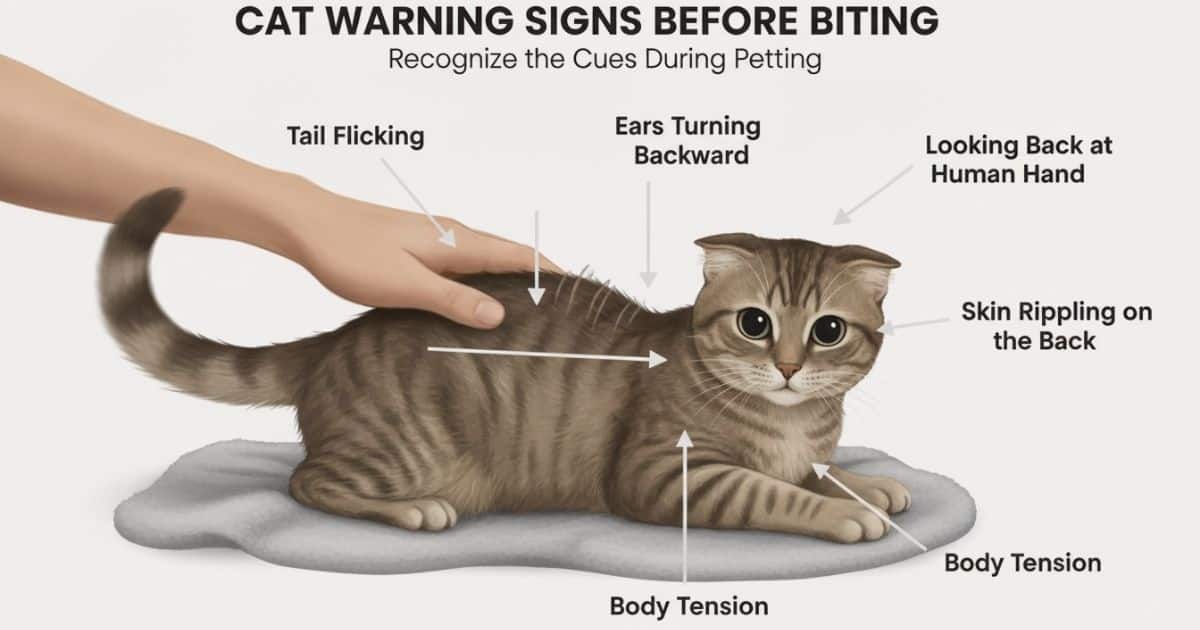
Tail Starts Flicking or Thumping
A flicking or thumping tail often signals irritation or overstimulation — the opposite of what a wagging dog tail means. When my cat was getting tired of petting, the tail was almost always the first sign. Slow flicks built into stronger ones. A tail whipping back and forth is usually your cat’s way of saying “please stop now.”
Skin Rippling on the Back
Rippling or twitching skin along the back can signal overstimulation building up, sometimes appearing seconds before a bite or swat. The first time I noticed it, I thought a fly had landed on my cat. Treat it like an early warning light on a dashboard.
Ears Turning Sideways or Backward
Ears that rotate sideways or flatten backward often signal discomfort. A relaxed cat usually keeps its ears forward; as annoyance builds, they shift. Watching for this single cue alone predicted almost every bite my cat ever gave me.
Dilated Pupils
Large pupils can signal excitement, stress, fear, or overstimulation. One signal alone may not mean much, but several signals together — wide pupils plus tail flicking plus body tension — tell a much clearer story.
Sudden Body Tension
A relaxed cat has loose muscles and an easy posture. When discomfort builds, the body tightens, sometimes shifting from loose to rigid in an instant. That sudden change was often followed by a bite if I kept petting.
Looking Back at Your Hand
A cat that suddenly turns and stares at the hand touching it is often issuing a final warning. Treat it like a yellow traffic light — not always a guaranteed bite, but a clear signal to slow down.
Low Growls or Vocal Warnings
Growling, hissing, or sharp vocal sounds clearly communicate “I want space.” These sounds are often the last request before a defensive reaction, and they should never be ignored.
Quick Checklist: Signs to Stop Petting Immediately
Stop petting if you notice one or more of these signs:
- ✔ Tail flicking or thumping
- ✔ Skin rippling on the back
- ✔ Ears turning sideways or backward
- ✔ Dilated pupils
- ✔ Sudden body stiffness
- ✔ Looking back at your hand
- ✔ Growling, hissing, or other warning sounds
- ✔ Quick head turns toward your hand
- ✔ Swishing tail combined with tense posture
How to Stop Your Cat From Attacking You After Petting
The best approach is to learn your cat’s limits, watch for warning signs, avoid trigger areas, and end petting before overstimulation sets in. The goal isn’t to make your cat accept more touch — it’s to understand what your cat actually enjoys and respect those limits.
Learn Your Cat’s Personal Limits
Every cat has a unique threshold, and learning it prevents most petting-related bites. Some cats enjoy ten minutes of attention; others prefer thirty seconds — neither is wrong. Factors that affect the limit include personality, age, energy level, stress, health, and past experience.
End Petting Before Overstimulation Starts
Stop while your cat is still enjoying the interaction, rather than waiting for the bite. This single change transformed my experience — instead of petting until she reacted, I stopped after a short session, and she often stayed beside me afterward instead of biting or walking off. Watch for early signs: tail flicking, ear movement, skin twitching, looking back at your hand, body stiffness.
Focus on Preferred Petting Areas
Most cats prefer contact around the chin, cheeks, and head.
- Chin: Cats have scent glands here, and gentle scratches are usually well received.
- Cheeks: Also rich in scent glands — many cats lean or push into a cheek scratch as a way of asking for more.
- Head: A safe starting point for most cats; watch the response and adjust accordingly.
Avoid Known Trigger Areas
Common trigger areas include the belly, tail base, paws, and back legs. If a spot consistently causes a reaction, respect that boundary rather than testing it again.
Let Your Cat Initiate Contact
Cats often respond better when they choose when petting begins. Waiting for your cat to come to you, rather than reaching for her constantly, reduces frustration because she retains a sense of control over the interaction.
Use Positive Reinforcement
Reward calm, relaxed behavior during short petting sessions with praise, a favorite toy, or a small treat. Avoid punishing a bite — cats don’t learn well from punishment, and it tends to add stress rather than reduce it.
Increase Daily Playtime
Cats with extra pent-up energy often redirect it into petting sessions. Regular play — wand toys, feather toys, toy mice, puzzle feeders, hide-and-seek with treats — gives that energy a healthy outlet. A tired cat is usually a more patient one.
Reduce Environmental Stress
Stress lowers a cat’s patience for touch. Try to provide safe hiding spots, consistent daily routines, quiet resting areas, and undisturbed access to food, water, and litter boxes. A cat that feels secure is generally easier to read and easier to pet.
Common Mistakes Cat Owners Make
Many cats bite or scratch after petting because owners miss warning signs, push past limits, or touch disliked areas. When I first ran into this problem, I looked only at my cat’s behavior — later, I looked at my own. That shift changed everything.
Ignoring Warning Signs
This was my biggest mistake. I thought my cat bit without warning, but I had simply missed the signs — tail flicks, ear shifts, a stiffening body — every single time. Think of these as a yellow light telling you to slow down before the red.
Forcing Affection
More affection isn’t always better. A good petting session is a two-way conversation; petting went far better once I let her initiate rather than reaching for her on my own schedule.
Punishing the Cat
Punishment doesn’t stop petting aggression and often makes it worse, since most bites stem from stress, overstimulation, fear, or simply being “done,” and adding punishment on top adds more stress. Instead: stop petting, give space, look for the cause, and watch more closely next time.
Assuming All Cats Like Long Petting Sessions
Comparing your cat’s tolerance to another cat’s is a common trap. Every cat’s threshold is different, shaped by personality, age, mood, health, and stress level.
Touching Sensitive Areas Too Soon
Belly, paws, tail base, and back legs commonly trigger reactions, while chin, cheeks, head, and the area around the ears are generally safer starting points. If your cat reacts strongly to handling in these zones — not just during petting but during brushing, nail trims, or general grooming — a professional cat groomer experienced in low-stress handling can make routine care far less stressful for both of you.
When Petting Aggression Could Be a Medical Problem
Sometimes the reaction isn’t behavioral at all — it’s pain, skin trouble, or another health issue.
Arthritis
Common in older cats, arthritis causes joint pain that can make a cat react when a sore area is touched. Signs include trouble jumping, stiff or slow movement, reduced play, and a new dislike of being touched.
Skin Conditions
Fleas, allergies, skin infections, dry skin, and rashes can all make normal petting painful. Watch for excessive scratching, hair loss, redness, scabs, or over-grooming.
Neurological Disorders
Less common, but nerve-related issues can make ordinary touch feel painful or strange, sometimes producing a startled or exaggerated reaction to light contact. Watch for poor balance, head tilting, unusual gait, or extreme touch sensitivity.
Chronic Pain
Cats are skilled at masking pain, so subtle changes — spending more time alone, becoming less tolerant of touch — can be early signs of joint pain, dental disease, old injuries, or other chronic conditions.
Hyperesthesia Syndrome
A rare condition, usually affecting the back, where a cat becomes unusually reactive to touch. Signs include rippling skin, tail chasing, sudden running, excessive grooming, and strong reactions to light contact. A vet visit can help rule this in or out.
Red Flags That Require Veterinary Attention
See your vet if the aggression is new, severe, or paired with other signs of illness:
- ✔ Sudden aggression
- ✔ Aggression getting worse
- ✔ Limping or stiff movement
- ✔ Pain when touched
- ✔ Hair loss
- ✔ Loss of appetite or weight loss
- ✔ Hiding more often
- ✔ Trouble jumping
- ✔ Poor balance
- ✔ Extreme touch sensitivity
A bite isn’t always bad behavior — sometimes it’s a cry for help.
What I Learned From Living With a Cat That Attacked After Petting
My cat wasn’t attacking me for no reason. She was telling me she’d had enough, and I simply hadn’t learned to listen yet.
The Biggest Mistake I Made
I assumed a purring cat always wanted more petting, so I kept going — and that caused most of the bites. The signs were there the whole time: a tail flick, ears moving back, a tightening body. The bite was never the first warning. It was the last one.
How I Changed My Approach
I stopped pushing for more petting and started following her lead — letting her come to me, giving her space when she wanted it, and keeping sessions shorter. I paid close attention to body language and stuck to the areas she liked most: chin, cheeks, and head. The more I respected her choices, the fewer bites I got.
The Results After Respecting Boundaries
Fewer bites was the obvious outcome, but something else happened too — she spent more time near me, asked for attention more often, and seemed to trust me more. She’d learned I would actually listen when she’d had enough.
Advice for Other Cat Owners
Watch your cat closely and respect their limits. Don’t focus only on the bite itself — focus on what happens right before it. A few practical habits help:
- Let your cat start the interaction
- Keep petting sessions short
- Avoid areas your cat dislikes
- Give daily play time
- Talk to your vet if behavior changes quickly
My cat wasn’t trying to be mean. She was trying to communicate, and once I started listening, our bond became much stronger.
FAQs
Why does my cat attack me after petting him? Most cats attack after petting because they become overstimulated or want the interaction to stop. What starts as enjoyable can suddenly feel uncomfortable, leading to a bite, swat, or scratch.
Why does my cat bite me when I pet him? A bite during petting is often a form of communication — your cat may be saying “I’ve had enough.” Overstimulation, excitement, or a desire for space are common reasons.
Why does my cat scratch me when I pet him? Scratching usually happens when a cat feels uncomfortable, startled, or overwhelmed. Many cats show warning signs first, such as a twitching tail, flattened ears, or tense body language.
Why does he bite me after I pet him for a few minutes? Many cats have a petting limit. They may enjoy attention at first, but after a few minutes the sensation becomes too intense, causing them to react.
Is petting aggression normal in cats? Yes. It’s a common behavior and usually reflects a cat’s personal boundaries rather than true aggression.
What is redirected aggression, and how is it different from petting aggression? Redirected aggression happens when a cat is aroused by something else entirely — another animal, a sound, motion outside a window — and takes that energy out on whoever is nearby, including someone petting it. It tends to come on faster and with less warning than ordinary overstimulation.
Should I stop petting my cat altogether? Not usually. Most cats still enjoy affection. Shorter petting sessions and focusing on favorite spots can help.
Can cats grow out of petting aggression? Some do, especially when their boundaries are consistently respected. Others keep the same touch preferences throughout life.
When should I see a vet? If the behavior appears suddenly, gets worse, or comes with signs of pain or illness, a veterinary checkup is a good idea.
Conclusion
Most cats attack after petting because they get overstimulated, want space, or feel done with touch. It isn’t random — it’s a message. Your cat may enjoy contact at first, then reach a limit, and when that limit is hit, a bite or scratch can follow. From my own cat, I learned this the hard way: a tail flick, a quick ear turn, a stiff body — these signs came before every single bite. Once I noticed them, things changed fast.
Cats don’t act without reason. They speak through body signals, and when you slow down and watch closely, trust grows. Petting becomes safer, and your bond gets stronger.
If your cat won’t tolerate handling even for basic care — brushing, nail trims, or routine grooming — a professional, low-stress mobile cat groomer can make a real difference for touch-sensitive cats. And if you’re ever unsure whether what you’re seeing is behavioral or a sign of something medical, reach out to our team — we’re happy to help you figure out the next step.